
Why Insight Is Not Enough for Lasting Change
Updated: Jun 29

Many people reach a point where they can explain their patterns very well. They know why they fear intimacy. They know why they procrastinate. They know where their perfectionism comes from. Yet, in crucial moments, almost nothing seems to happen. The old response repeats itself.
This can be deeply frustrating. A person may begin to believe that something is wrong with them because they already “know” where something comes from. Often, however, the problem is not a lack of willpower, but a misunderstanding of what change actually requires. Insight is not the same as change.¹ ²
Insight is valuable. It provides meaning, language, and orientation. It helps a person see more clearly what is happening within them. Sometimes this alone brings an important shift: less inner confusion, less self-blame, and a greater understanding of one's own process. Yet insight itself does not necessarily transform regulation, bodily responses, automated patterns, or the way the system activates in real-life situations.² ³
When Understanding Outpaces the Gradual Transformation of Inner Organization
At this point, an important distinction emerges between understanding and the gradual transformation of inner organization. Understanding means that I can name something. The gradual transformation of inner organization means that my system begins to respond differently.
Not only in explanation, but in perception, in the body, in boundaries, in decisions, and in the way I relate to intensity. This is usually a slower process. It requires more presence, greater capacity, and deeper integration than people often wish to acknowledge.¹ ³
For this reason, it is not unusual for someone to understand a great deal and yet still return to old responses in decisive moments. If a pattern has become automated over time and is linked to recurring contexts, cognitive insight alone is often insufficient to produce lasting changes in behaviour or inner activation.² Similarly, research on motivation and internalization suggests that lasting change depends not only on understanding something, but also on whether a new orientation becomes genuinely internalized and develops into a more integrated way of functioning.³
When Narrative Outpaces Integration
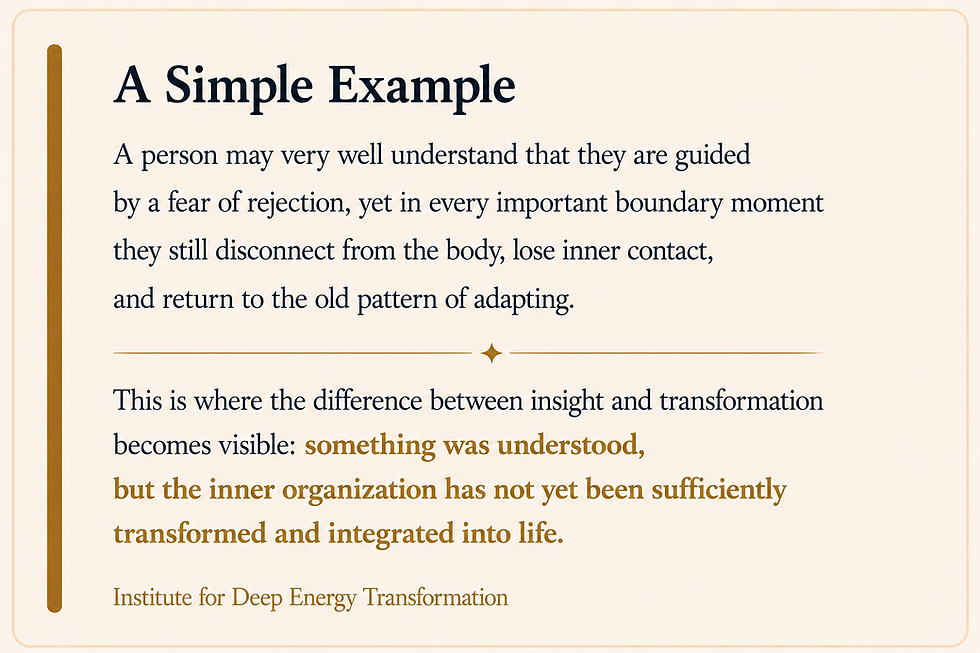
Within the methodology of the Institute, we therefore distinguish between knowing something about oneself and genuinely undergoing a gradual transformation of inner organization. A person may speak eloquently about their vulnerability and yet immediately close off in actual relational contact. They may explain their boundaries with great precision while still being unable to perceive them in their body when it matters most. They may understand that fear is guiding them and yet continue making decisions from the same inner compulsion.
In such cases, narrative outpaces integration.
Insight can therefore sometimes function defensively. Not because insight itself is wrong, but because it creates the impression of movement while the body, regulation, and relational reflexes remain largely unchanged. At that point, the process becomes confined to the level of explanation. Outwardly, it may appear that a person has come a long way. In reality, a new explanation of oneself has outpaced the gradual transformation of one's way of being.

Why a Clearer Map Matters
A serious methodology does not stop at asking what a person has understood. It also asks: has what they discovered become more directly perceptible? Can they remain present without immediately disconnecting or becoming overwhelmed? Has their new orientation already touched their boundaries, decisions, relationships, rhythm of life, and the way they hold themselves?
Without these questions, insight is often evaluated too quickly and too optimistically.
This does not mean that insight is unimportant. It simply means that it must be situated within a broader process. Insight can open the door, but it cannot do the work on behalf of the person. Lasting change often also requires regulation, repeated experiences of responding differently, greater connection with the body, new relational experiences, and gradual integration into life.² ⁴ ⁵
If you are in a phase where you understand a great deal but change has not yet stabilized, this is not necessarily a sign of failure. It may be a sign that you need a methodology that includes regulation, integration, and the gradual transformation of inner organization—not understanding alone. This is where the difference between intellectual understanding and lasting transformation becomes visible.
If you would like a more precise map of personal transformation, follow the methodology of the Institute and explore our future content, the Methodology page, the Glossary, and our Programs.
Notes
¹ James O. Prochaska and Wayne F. Velicer, “The Transtheoretical Model of Health Behavior Change,” American Journal of Health Promotion 12, no. 1 (1997): 38–48.
² Wendy Wood and Dennis Rünger, “Psychology of Habit,” Annual Review of Psychology 67 (2016): 289–314.
³ Richard M. Ryan and Edward L. Deci, “Self-Determination Theory and the Facilitation of Intrinsic Motivation, Social Development, and Well-Being,” American Psychologist 55, no. 1 (2000): 68–78;
Edward L. Deci and Richard M. Ryan, “The ‘What’ and ‘Why’ of Goal Pursuits: Human Needs and the Self-Determination of Behavior,” Psychological Inquiry 11, no. 4 (2000): 227–268;
Richard M. Ryan and Edward L. Deci, “Intrinsic and Extrinsic Motivations: Classic Definitions and New Directions,” Contemporary Educational Psychology 25, no. 1 (2000): 54–67.
⁴ Jürgen Füstös, Klaus Gramann, Beate M. Herbert, and Olga Pollatos, “On the Embodiment of Emotion Regulation: Interoceptive Awareness Facilitates Reappraisal,” Social Cognitive and Affective Neuroscience 8, no. 8 (2013): 911–917.
⁵ Richard D. Lane, Lee Ryan, Lynn Nadel, and Leslie Greenberg, “Memory Reconsolidation, Emotional Arousal, and the Process of Change in Psychotherapy: New Insights from Brain Science,” Behavioral and Brain Sciences 38 (2015): e1.
© 2026 Maja Škvarč – Institute for Deep Energy Transformation.
This article is an original work and forms part of the methodology of deep energy transformation. Reproduction or use without prior written consent is prohibited.


Comments